
Social policy is a package of public interventions that aim to guarantee adequate and secure livelihoods, income and well-being, and that enable all individuals to strive for their own life goals. When the Structural Adjustment Programme introduced in 1986 was adopted and implemented by Nigeria at a time of depressed oil prices as social policy at the suggestion of the World Bank, it was hoped the strategy holds the key to eradicating poverty facing the multitudes of their people. Three decades after it was first launched, it has proven to be an abysmal failure. Reasons for this has been widely assessed in different fora among various stakeholders and is not the purpose of this article.
Realising that the SAP has underperformed and the risks and opportunities associated with neoliberalisation, Nigeria since 2015 seem to have started reviewing their stance towards social policy and programmes. This, however, is not to say that the neoliberal force on agenda setting has weakened. In light of contemporary development context of sustainable development goals, it is imperative to assess whether new policy options and approaches are fundamentally different from what used to obtain.
State-led social policy plays a significant role in development and social welfare. The government of a country is primarily responsible for erecting structures to guarantee the welfare of its people. However, this has been largely challenging for Nigeria. Much of the new range of policy choices seem to be disparately applied, inconsistent and poorly understood. This article carefully examines these new policies in Nigeria. Answering this question will be important for understanding whether they offer viable approaches for tackling social development challenges facing the country today.
Protection
Social protection involves those policies and programmes meant to reduce people’s vulnerability and exposure to risk by promoting efficient labour markets and enhancing their capacity to manage economic and social shocks such as unemployment, sickness, disability and old age. Since the launch of the Sustainable Development Goals in 2015, the Nigerian government have prioritised social protection streams.
The National Social Investment Programme (NSIP) is a portfolio of programmes launched in 2016 by the Nigerian government to deliver socio-economic support to the disadvantaged Nigerians across the Nation. The Job Creation and Youth Employment (N-Power) is focused on getting unemployed Nigerian youths in a cash transfer scheme which pays them a monthly stipend of #30,000 monthly for three years. Government Enterprise and Empowerment Programme called TraderMoni is a government interest free loan programme for petty traders and artisans for amounts ranging between #10,000 and #100,000. From the Social Investment Programme comes National Home Grown School Feeding Programme which provides lunch to primary school children to improve the enrolment of primary school children and reduce the current dropout rates. National Cash Transfer Programme provides monthly supplemental income support of #5,000 to one million poorest households.
These schemes are haphazardly implemented and qualification requirements, in practice, is unclear. Labour policies and laws must be reviewed as there are still gaps in them which does not adequately protect the people like unpaid salary and allowances, check predatory private employers, benefits and support for people of working age in case of maternity, disability, work injury; and pension payment for retired workers is still dismal. The National Social Insurance Trust Fund is the government agency established to provide assistance through social insurance, tax-funded social benefits, and other similar schemes guaranteeing employee security but not yet widely accepted. With high number of informal workers and changing nature of work in the country, the condition of having an employer to benefit from the fund need to be discarded.
Services
Services such as energy, telecommunications and transportation; financial services which facilitate transactions and provide access to finance for investment; health and education services which contribute to a healthy, well-trained workforce; legal and accountancy services as well as security underpin a healthy social policy. While decent progress has been made in telecommunications and transportation, the country has not made remarkable progress in areas of energy, finance for investment, health and education services. Spending on services has not seen an increase from what used to obtain. The National Bureau of Statistics has improved its data indices on access to services in recent years and it is important that the government builds for better policy decisions but more needs to be done in household surveys to further capture deprivations.
Institutions
A country’s institutional arrangement is a crucial aspect of social development policy. They implement the policies and also influence the rules of the game which conditions the practice of social development. A Ministry of Humanitarian Affairs, Disaster Management and Social Development is the custodian institution for social development policy implementation. Being a federal administrative structure, effectiveness of the local government is particularly important to poverty eradication and sustainability of programmes by localising the different cultural, climatic, and economic zones of the country.
The judicial system has also degenerated and fair dispensation of justice is not always guaranteed. Critical institutions remain weak and ineffective due to decades of underfunding, corruption, politicking and low initiative. Structure of accountability in social policy design and implementation is also unclear making policy coordination among government institutions challenging.
Civil society organisations have been muzzled since 2015 as the government continue to crack down on those with alternative opinions. Human rights organisations like Amnesty International have been asked to leave and collaborations with and support of CSOs have progressively weakened. Universities and international agencies and the private sector are all critical stakeholders. While international agencies have been a key partner in social policy programming in the country, this cannot be said of others. Universities are not adequately fulfiling their duty to society by influencing discussions or decisions regarding poverty.
Markets are an important aspect of institutions. They are tools to help realise the kind of society human beings have reason to value through access to goods that satisfy people’s preferences. Nigeria’s market mechanism remains complex and contradictory, and economic policies do not often revolve around efficiency, equitability, sustainability and empowerment. The conditions of the people constituting the human capital that goes into factors of production are crucial to the overall market system but are merely seen as means and not ends in themselves.
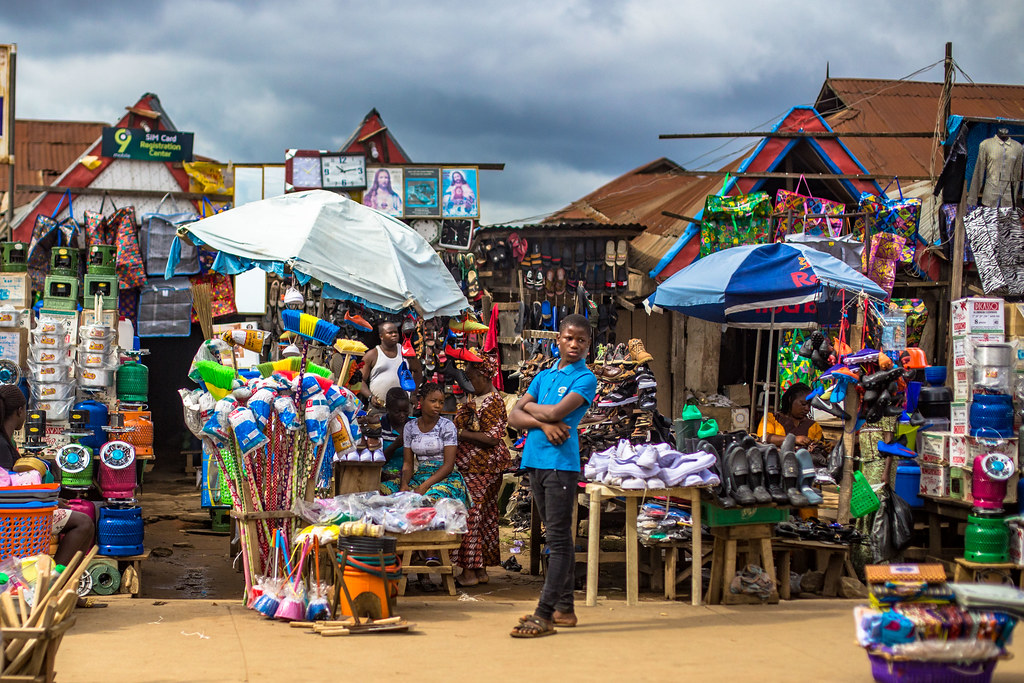
The informal sector is important to the country’s employment contributing 65% of Nigeria’s 2017 GDP. Much of the businesses are precarious due to harsh operating environment including poor infrastructure, weak financial base, security forces repression, power politics, poor regulatory control and policy implementation. Strategies to ease business and economic diversification plans launched by the government in 2017, although with some improvements, still face problems of shortage of skilled labour, infrastructure deficit, exchange rate volatility, low productive capacity, poor wages, tax payments, the security of property, cost of operation and major reliance in oil revenue. Although tradeoffs are inevitable in improving markets, more effort should be made in giving it a human face by putting people first.
Political participation
Political participation is another important social development policy stream. At the heart of the democratic practice, it includes attempting to influence the activity of government and the selection of officials, trying to affect the values and preferences guiding the political decision-making process and seeking to include new issues on the agenda. In Nigeria, this is highly influenced by the prevailing political landscape and domestic interests and alliances irrespective of the sector. Creation of policies for improving homegrown ideas and grassroots voices have not seen an active input in the country.
The most significant discussion in this regard is the call for administration decentralisation which has not been accepted by the central government. As a multiethnic country, it is important that inequalities in political participation are minimal, and nepotism and favouritism are sanctioned. Although the Federal Character Commission was established to achieve this by giving voice to the over two hundred and fifty ethnic groups in the country and ensure balance, this has always been a challenge and probably worsen in the past five years. Ensuring fairness in the distribution of socio-economic amenities which is its second mandate cannot be achieved without political participation. Their mandates need to be expanded to include active facilitation of political engagement especially at the local level and independence from the executive as it impedes its effective functioning. Also important is the suspension of the indigene-settler dichotomy guiding access to socio-economic services.
While protests have been met with some resistance through military crackdown, internet discussion groups and cyberactivism have significantly increased citizens’ voice. Currently, there is a debate regarding the need to regulate online discussion particularly the social media due to fake news. While there is no evidence that membership in political parties, interest groups, and voluntary associations have increased, unconventional participation and new social movements are rising and demands greater attention by the government in her social policy development. Aside from the growth of technology and internet access, this condition flow from a dynamic interaction between the people and the wider institutional and political contexts.
Social inclusion
Social inclusion concerns the question of who are those people benefitting and discriminated from having their needs met. It recognises that every individual has rights and improving the ability, opportunity and dignity of those disadvantaged based on their identity. Children and youths, girls and women, internally displaced persons, disabled persons, the elderly, and ethnic minorities are some of the most socially excluded groups in the country. Inexistent service regulation, corruption, nepotism, culture, poor policy implementation are some factors hindering these segments of the Nigerian population from accessing services and participation. These have implications for their human security. With the SDG aiming to boost shared prosperity by 2030, the country will need to enact policies and limit exclusionary tendencies to the minimum. However, merely enacting policies is not enough but a rejig of the institutional framework is also required and translate it into better equity outcomes.
Rounding up
Nigeria has not introduced adequate innovative social policies to meet contemporary development challenges. As the world has ten more years left towards meeting the Sustainable Development Goals, it is imperative that the country design more transformative approaches to social policy that responds to the national challenges identified. A good place to start is stopping excessive public spending used in funding its over-bloated governance structure and invest heavily in education, health, technology and innovation.
Also, a census and building a national multidimensional poverty index are needed. These will be vital for monitoring poverty trends, evaluating poverty reduction policies, national planning, SDG prioritisation, intra-government coordination across ministries, budget allocation and policy formulation. Whether the country is now a neoliberal democratic or social democratic considering a growing welfarist approach to social policy does not matter more than the urgent need to introduce and implement home-made policy structures and patterns which genuinely prioritise human flourishing.
Bolaji Ogunfemi is the Administrator of Afrodevelopment. He can be reached on b.ogunfemi@afrodevelopment.org or on Twitter @BolajiOgunfemi.
 afrodevelopment.org