

Bolaji Ogunfemi
It was the afternoon of Tuesday 4th of July, 2017, different thoughts ran through my head as I was approaching departure lounge of Heathrow Airport Terminal 4 to check in for my flight to Nairobi.
I was travelling to Juba, South Sudan for the fieldwork of my research titled- Sanitation and Human Security in South Sudan, and up to this point, I really did not know what to expect as I embarked on the journey.
As I handed over my passport to the airline staff at the counter, she questioned me out of curiosity of my reasons of going to South Sudan. Her questions centred on my intentions of flying to a war-torn country where people are escaping from in their thousands. Little did I know that I would be answering her questions and defending my choice all through my stay in the country.
My connecting flight to Juba landed the following day at 9:20am at the airport. The airport was a makeshift tent with old wooden planks, some of which have huge holes in them as flooring. I went to the immigration section to have my passport stamped then waited to get my bag which arrived few minutes afterwards. After about two hours driving around the city in search of hotel rooms, I eventually got a relatively cheap one at Hai Thora which is about five minutes’ walk from the University of Juba at Atlabara.
I was determined to hit the ground running because of the insecurity and expensive living in the capital.
My first port of call the next morning was the UNICEF office at Tong Ping with Dr.Leben Moro, the Director of Centre for Peace and Development Studies at University of Juba. UNICEF is responsible for coordinating the humanitarian and development sanitation interventions in the South Sudan and they also provide funding to partners through their WASH Cluster. Dr. Moro also connected me with UNDP and the Ministry of Electricity, Water, Dams and Irrigation where I received some secondary documents. The documents provided me with a greater insight into the national context of South Sudan and policy background to the research topic.
Key informant interviews commenced a week after reviewing secondary materials to guide my research and ensure appropriate questions are asked. “Current sanitation situation in South Sudan is horrible, so we are really struggling in this bizzare setting”, a WASH staff of one of the UN specialised agency told me. This opinion resonated with all other WASH partners in the country.
South Sudan’s prolonged conflict has defied solution and this has affected sanitation and human security in the country both at an individual, communal levels and national levels. Cost of sanitary materials has sky rocketed up to twenty times than it obtained in 2013.
Getting latrine materials to the war-ravaged states up north like Jonglei and Wau can only be done by air because the roads are bad and unsafe. This option is expensive and frustrates ability of humanitarians to provide people with needed sanitation services considering the additional challenge of flooding common to the region.
“Some will tell you my priority is to get food for my children, how can you expect me to buy a slab of about 1,000 SSP when I can go and buy a bag of maize or sorghum so my children can survive. When such statements come up, you cannot push.” The WASH Manager of a national NGO which used to implement CLTS before the outbreak of the December 2013 war recounted.
He attributed the cause of breakdown in economic activities and low motivation for sanitation to displacements due to fighting not only from the power tussle at the centre but also inter-communal cattle rustling, as cattle plays key economic role in South Sudan.
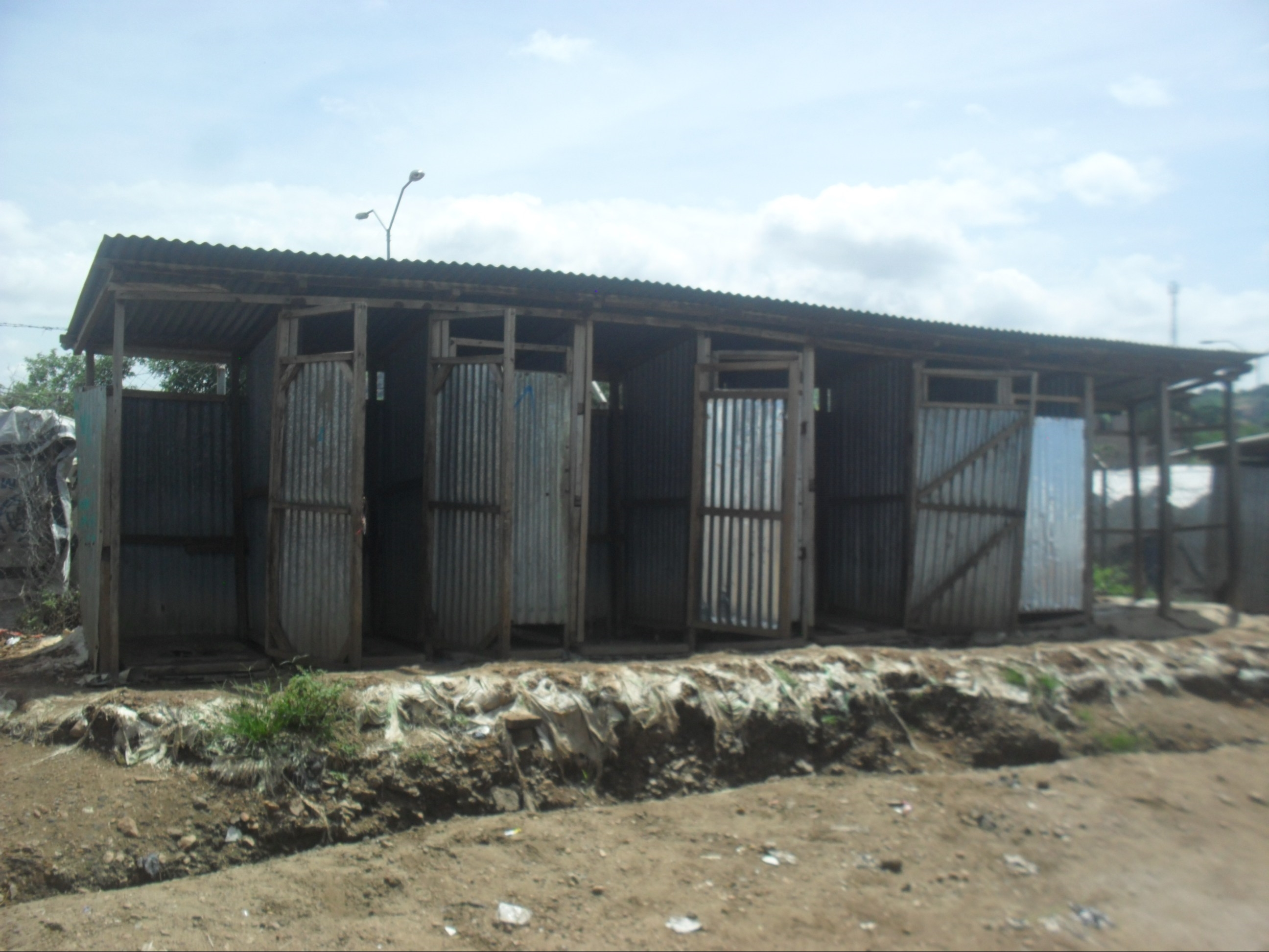
Technical challenges are also significant as the black cotton soil is common in the country. This type of soil collapses toilets and latrines or could also cause them to sink during rainy seasons. In fact, one of the reasons behind the closure of the Tong Ping POC camp north of the capital city was because of the black cotton soil which resulted in the collapse of numerous latrines during rainy seasons.
However, ingenious measures are being introduced by WASH partners which include using drums as reinforcement of pit and burning the soil around the pit wall to prevent them from collapsing. Unfortunately, these drums as well as other materials like pit liners and cement can only be transported by air which is prohibitively expensive. Gumbo village under Rejaf Payam, situated about 6 kilometres south-east of Juba across the White Nile, where some of the highest cholera cases in Juba and its environs have been reported has some areas with this type of soil.


Socio cultural preference for open defecation is another recurrent theme in my finding. Some partners spoke of their experiences, whereby community elders in villages declared that they do not need latrines. This thought was adopted from the idea that their fore fathers practiced open defecation and nothing happened to them. “They can be very resistant and you know they influence, so if you have no way of mobilizing them they can stop the project,” an NGO staff said.
Although hygiene education is slowly changing the narrative, the Director General of Rural Water and Sanitation called for intensified hygiene awareness. According to him, taboos like not sharing latrines with in-laws and not defecating near houses of abode are propagated by poor education level.
Open defecation is also rampant in Juba where people told me they are staying in their current place of abode temporarily and may be moving to another place in a moment’s notice while those who had no plan to leave do not own the land and cannot consider building a latrine. Land is a highly sensitive and politicized phenomenon in Juba. “If you dig ordinary hole in your compound today, you may be asked to leave the next day” a participant of the youth focus group discussion held in Lologo, a flood-prone and host community south of the capital told me.
Fewer people in this community reported sharing latrines compared to Gumbo as many practice open defecation. At night, residents including those who own latrines, defecate in plastic bags and then dispose it in the morning due to insecurity. A participant of the men group discussion said: “If you go out at night, it might be your neighbour that will shoot you, nobody will come to your rescue, and if anyone does, no medical facilities is available to treat you.”


Those who practice open defecation in Gumbo refrain from going into the bush even during the day and would rather use open fields like the one pictured below or the bank of the Nile River. “If you go into the bush, you can get shot, so I always use the neighbour’s toilet,” a participant in the women’s focus group discussion explained. Women express significant stress and shame using their neighbour’s latrine and avoid use particularly during their menstrual cycle.
The WASH Strategic Framework formulated in 2011 recommends community oriented sanitation service delivery approach. Opinion is, however, divided between the government, WASH Cluster, NGO and donors about the practicality of CLTS.
While nearly all partners see CLTS as impractical, the Director- General of Rural Water Supply and Sanitation at the Federal Ministry of Electricity, Dams, Irrigation, and Water Resources argued otherwise. He explained that abandoning CLTS and focusing on building latrines may be unsustainable in the long term as displacements of people from their communities continues.
He showed me photographs taken at Lopa village in Torit, Western Equatoria which became open defecation free in May 2016 but later became empty after the fighting of July 2016 broke out. Although he praised the effort of the people to become open defecation free with only triggering, “this will impact negatively on the cause of sanitation ladder to grow as people will have to start from the scratch every now and then” he said.
The Directors of Public Health for Kator and Rejaf Payam were also affirmative in their belief that a CLTS oriented sanitation service delivery will not work in urban settings including the capital Juba. The results of past implementation in the capital in 2009 were poor according to the Director- General reasons for which he attributed to lack of urban planning, non-implementation of existing ones, geometrical displacement of people from villages to the city and incessant population movements within the town. He identified a communal latrine system for the densely populated peri-urban communities as a possible solution.
The aim of the research is to test my SANITATION SECURITY model with the aim of making theoretical and analytical generalization beyond the case of South Sudan as to the connections between sanitation and human security.
Target two of goal number six of the United Nations sustainable development goals seeks, ‘by 2030, to achieve access to adequate and equitable sanitation for all and end open defecation, paying special attention to the needs of women and girls and those in vulnerable situations’
Data collection was rounded up at the UN House Protection of Civilians 1 camp in Juba with the disabled focus group discussion the morning of the day that I left the country. Despite the SDGs slogan of leaving no one behind, none of the latrines in the PoC is suitable for use by the physically vulnerable. Unfortunately, I was unable to present findings to the WASH partners as I had planned.
Away from academic activities, I got an invitation from the Centre for Peace and Development Studies at the University of Juba to give a presentation to Masters Students on my research journey from the formulation of research topic to fieldwork.
Savouring the cool breeze on a bodaboda – local name for commercial motorcycle – as I made my way to the airport on the hot sunny afternoon of August 23rd, the key challenge WASH partners told me they face rang through my head. Influencing behaviour change is bedeviled by numerous limitations in the country few of which I have highlighted above.
However, it can be better triggered using a modified CLTS approach which doesn’t prioritise facilities but behaviour change through traditional practices that respects and protect the environment. In addition to this, a multipronged approach is necessary as the technocratic classification of human basic needs preferred by planners and implementers are incompatible with people’s reality.
If South Sudan is the least country globally to find at least basic latrine and facing significant human security challenges then why can I not choose it as my case study?
Bolaji Ogunfemi is a PhD student in London and founder of Afrodevelopment. He can be reached on twitter @bulgie05 or b.ogunfemi@afrodevelopment.org.
 afrodevelopment.org
Interesting blog
LikeLiked by 1 person
Thank you sir. You made this possible.
LikeLike