

Many African countries lack the capabilities to plan, manage and do the research required for successful formulation, implementation and evaluation of policy. Data from the continent is generally perceived as inaccurate, unreliable, untimely or inexistent. The reasons behind this are numerous.
While statistics bureau exists in most countries, they are sometimes insufficiently funded. This condition hinders opportunity for recurrent training of staff on modern data collection strategies, promotes production of statistics with apprentice touch, and encourages aimless governance. Production of adequate, accurate and illuminating data is compromised in such instances.
Another reason can be found in lack of evidence-based national development plans. Most African countries develop national development plans at some point, but these are commonly designed without backing from data. Consequently, a chaotic plan, destined to fail even before implementation is produced. More hurtful to countries’ finances is funds wasted in implementation.
Independence of national statistical offices is suspect in most African countries. Government leadership sometimes interfere in their activities and data deemed unfavourable are sanctioned. In other climes where data are not denied, they are willfully ignored and have no impact on policy decisions or implementation.
In other climes, where data are available, they are willfully ignored and have no impact on policy decisions or implementation.
A further argument is that more Africans are not leading the narratives around survey and census data produced on the continent. While data is invaluable to ascertaining a country’s human development status, analytical and critical interpretations are what makes them not only nationally relevant but also brings them in comparable standings to regionally and globally determined metrics. For data to be useful and benefit those for whom they are collected, pattern of interpretations must conform to their realities.
As a last example, there a lack of development communication initiatives. Investments in public opinion polling is not a common practice of African national governments. Although the private sector may be making efforts in filling this role, it is largely insufficient. Governments on a more consistent and evidence-based basis need to acquire greater insight into the human development conditions of their citizens.
As a last example, there is a lack of development communication initiatives.
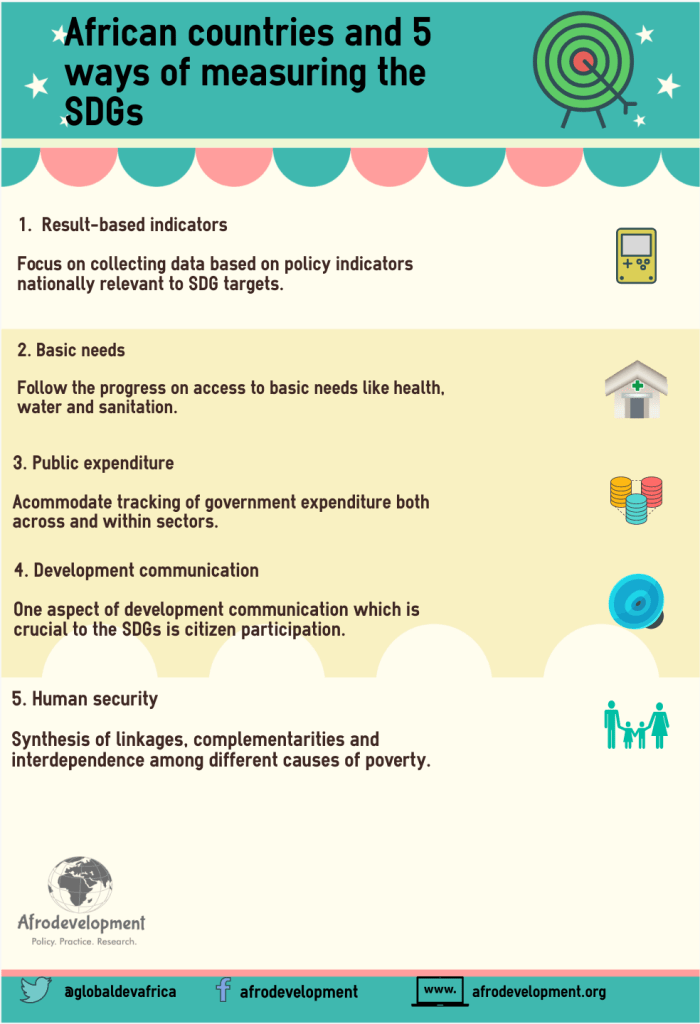
Each of the Sustainable Development Goals which are seventeen in number have targets which requires indicators. These indicators will be useful in monitoring changes over time towards attaining the goals. Having critically accessed the recurring themes of sustainability and equity embedded in these goals, a few practical suggestions for African governments will suffice;
- Result-informed indicators – There should be a focus on collecting data based on policy indicators nationally relevant to those targets specified in the SDGs. Although, the goals are ambitious, African countries should prioritise attainability dictated by their current development standing. This is crucial since dynamics vary from country to country and they will serve as foundation for judging progress as well as initiating and monitoring policies. Where necessary, qualitative measurement should be adopted for unquantifiable issues.
- Basic needs – Most national development plan and statistics historically revolves around basic needs like health and education, a demonstration of their importance to sustainable human development. Since many African countries are performing fairly on key development indicators, promoting access to basic needs should be a focus. It also ought to guide national planning for investment, production and consumption.
- Public expenditure – Measurement of progress in achieving the SDGs should accommodate tracking of government spending among sectors. Attention should be paid to what sectors or population segments are prioritised, allocation within sectors, and regions or settlement types. For example, some countries might need to fund tertiary education more than primary.
- Development communication – One aspect of development communication which is particularly crucial to measuring the SDGs is citizen participation or feedback. Production of diverse local content in local languages and seeking citizen engagement would be helpful in setting benchmarks at the grassroots level and evaluate implementation. Collaborations should also be sought with civil society, academics, districts and local government, private sector, and donors.
- Human security – One other option is adopting a human security approach to SDGs measurement. It enables a synthesis of linkages, complementarities and interdependencies between the numerous underlying causes of poverty. Conversely, it also allows identification of negative implications of policies or programs in one sector on other sectors. African countries can design a national development framework containing concepts from the human security approach to serve as benchmark for policy formulation, implementation and progress monitoring.
It must, however, be acknowledged that given the complexity of the SDGs, not all targets can be accurately measured. Efforts at developing appropriate measurements can greatly benefit from improved research culture in the continent which Elsevier is helping to address. The Centre for Global Development also partnered with African Population and Health Research Centre through the Data for African Development Working Group to encourage research for policy development on the continent. Wealth of research will be invaluable in determining which indicators provide the best insights and much more needs to be done in this regard.
One or a mixture of these measurement approaches can be adopted as what works for a country might not for another. But in the case of the latter, there would be tradeoffs and difficult choices which national governments must be willing to accommodate and address.
Bolaji Ogunfemi is an early career development consultant with interest in Africa and founder of Afrodevelopment. He can be followed on Twitter @bolajiogunfemi or email b.ogunfemi@afrodevelopment.org.


Measuring progress in SDG’s pertaining to the African situation makes an interesting case for investment in data management and improved security around collection, collation and distribution of this data. As you have clearly stated Africa’s governments seem the least responsive to data, showing almost no obvious correlation between what is proposed in areas of policy implementation and what is desired on the basis of timely relevant data made available to them at every step of the way.
Regarding the 5 ways you propose, I am of the opinion that public expenditure has a significantly higher chance of acceptance and implementation, particularly in the case of Sub-Sahara’s leading economies. As more political will gravitates towards accountable governance (and Anti-Corruption rhetoric). More evidence is required to justify public expenditure and this is a no-brainer even as it comes to the ordinary citizen where feedback is expected (Development Communication).
The problem in Nigeria for instance, despite of a Freedom of Information Act in effect since 2015 thereabout access is still restricted.
ON the other hand, Private sector participation and partnership initiatives present avenues for dedicated efforts at delivery of basic needs under a number of partnership modes as identified for example in Water & Sanitation infrastructure development in Asia and Australia. A combination of any two or even three of the proffered alternatives will go a long way if properly applied to any of the SDG’s and implemented with the sensitivity required for proper data management.
LikeLike
Howdy! This post could not be written any better! Reading through this post reminds me of my good old room mate! He always kept talking about this. I will forward this article to him. Pretty sure he will have a good read. Thank you for sharing!
LikeLike
Thank you Sadiq. I do agree with your positions. There is so much that public/private partnership can achieve as the SDG 17 affirms but when civil societies are seen as enemies of the state (for example humanitarian partners working on the Boko Haram insurgency and the Nigerian government), development opportunities remain stifled. At Afrodevelopment, we intend encouraging more debate regarding the links between data, research and development in Africa.
LikeLike